
In this article
Our Approach
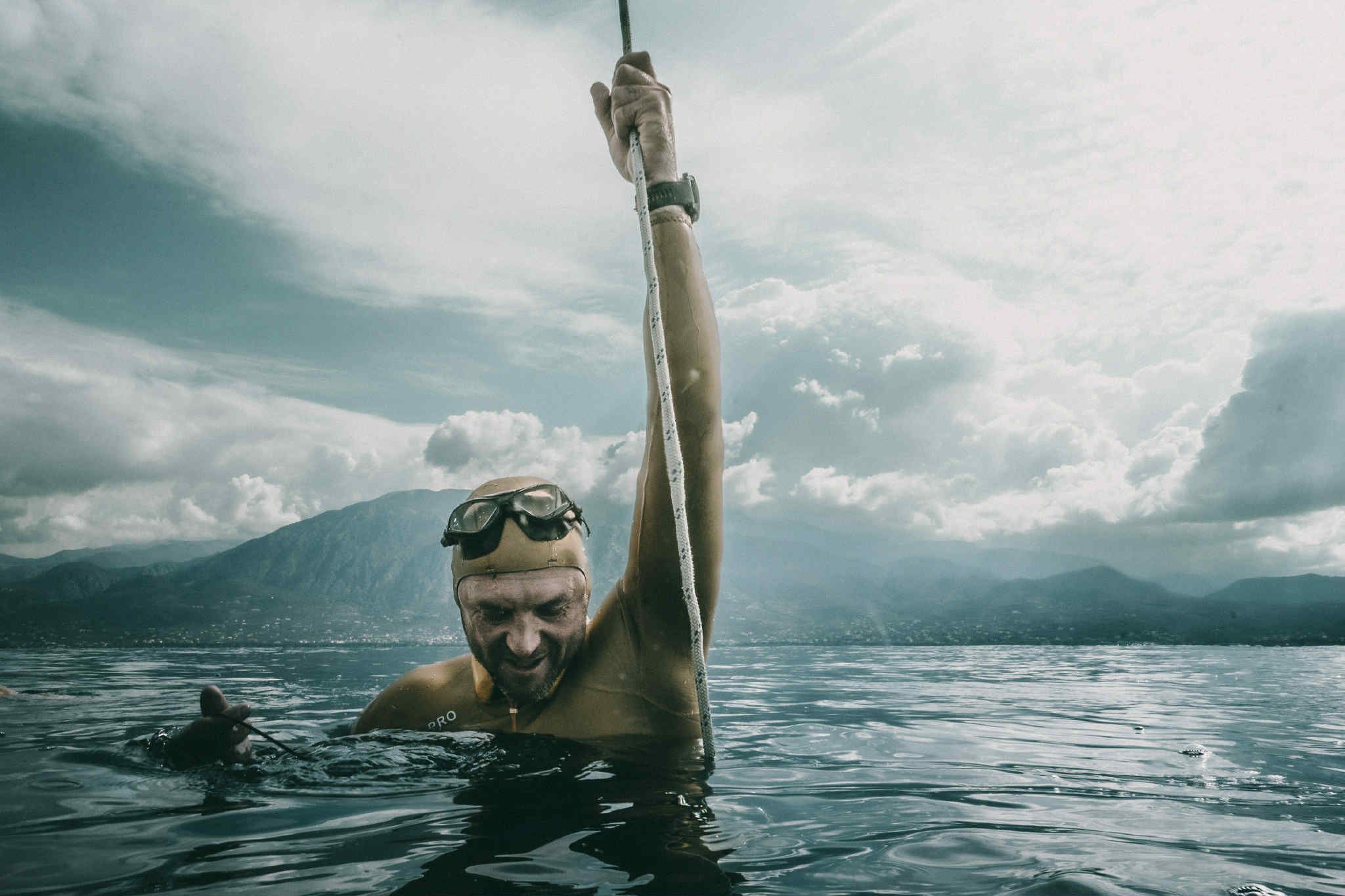
The sea is a mirror. It reflects exactly what’s happening in your body and your mind, with no delay and no room for pretending. If you’re stuck and can’t move forward underwater, something in you isn’t working the way it should. That’s not a failure — it’s an invitation to look a little closer.
This is the idea our whole approach is built on. Freediving isn’t just a sport we teach. It’s a tool for getting to know yourself, and for a lot of people, it ends up changing far more than how deep they can dive.
What actually separates a freediver from everyone else
It isn’t natural talent. It comes down to three things: knowing what to do, knowing when to do it, and having actually practiced enough for that knowledge to become real.
Theory matters, but on its own it’s not enough. Most of what we read, we forget — studies suggest we retain only a small fraction of what we study. That gap is where confusion and bad habits creep in. So we return to the same ideas again and again, until they’re not just understood but known by heart.
Practice is what proves theory right or wrong. And it takes more repetition than most people expect. Building new skill in the water means rewiring how your brain and body work together — a process scientists call neuroplasticity. That process needs time, and it needs volume. There’s no shortcut around it.
Why we go slow
Learning something new is, at first, mentally expensive. Your brain has to build an entirely new map — new sensations, new coordination, new judgment calls — and that takes energy and attention. Push too hard, too early, and stress takes over. Under stress, the brain defaults to old, automatic patterns instead of learning new ones. That’s why forcing progress almost always backfires.
Given the right amount of repetition, in the right order, something changes. Tasks that once required total concentration start to happen on their own. That’s when real progress opens up — not because you’re trying harder, but because you finally have the space to notice the small things that were getting missed before.
The three pillars
Everything we teach rests on three ideas: relaxation, focus, and sensitivity.
Relaxation isn’t a mood you chase — it’s simply the absence of tension. So instead of hunting for calm, we look for what’s creating tension in the first place, and work on that directly.
Focus is the ability to lock onto one thing — your technique, your equalization, your body position — and just as importantly, the ability to widen out and notice everything at once. Diving well means doing both, often within the same few seconds.
Sensitivity is how well you read your own body’s signals and respond to them honestly. This is harder than it sounds. Most of us have learned, often without realizing it, to override or ignore what we’re actually feeling. Learning to trust that feedback again — and to give it back to your coach honestly — is often the real work.
How we teach
Step by step. Simple before complex. We build a clear picture of where you’re strong and where you’re not, and we work with both — reinforcing what’s already working, and patiently developing what isn’t.
We don’t believe in dogma here. There’s no single right way to equalize, to breathe, or to relax — there’s what works for your body, discovered through honest trial and error, with guidance to keep you safe and moving in the right direction.
And above all: communicate. If something isn’t working for you, tell us early. That’s how we keep things simple, safe, and genuinely enjoyable — for you and for us.
Don’t believe us. Try it.
Written by
Gus Kreivenas
Founder of TOUCHDOWN. SSI, AIDA, and Molchanovs instructor, CMAS Instructor Trainer, competitive freediver.